

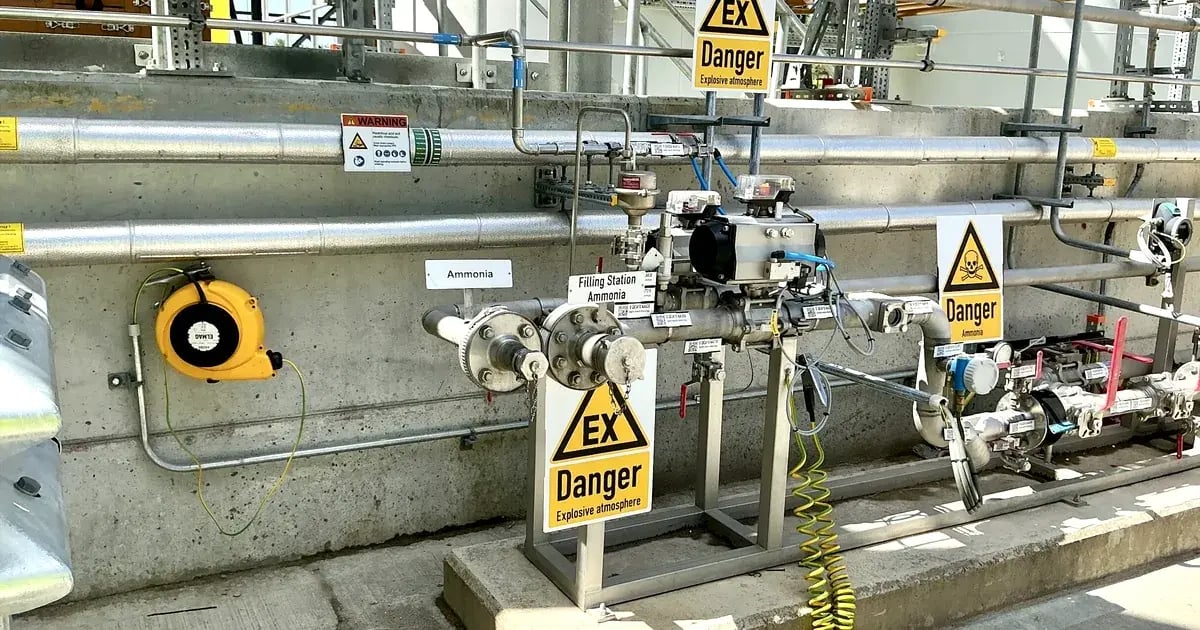
Short answer. A DSEAR risk assessment is needed wherever a workplace stores, uses or produces a dangerous substance, such as a flammable liquid, a flammable gas or a combustible dust, that could form an explosive atmosphere. It identifies the hazards, judges how likely an explosive atmosphere is to form, and sets out the control measures and hazardous area classification needed to keep ignition sources away from it.
What counts as a dangerous substance?
A dangerous substance, for DSEAR purposes, is anything that could catch fire, explode, or otherwise release enough energy to cause harm if it combines with air. That covers the obvious cases: petrol, solvents, LPG and acetylene. It also covers materials most people would not think twice about: paints, thinners and adhesives, aerosols, and dust from foodstuffs, wood or flour when it becomes airborne in high enough concentrations.
The Dangerous Substances and Explosive Atmospheres Regulations 2002 (DSEAR) originally focused on flammable liquids, gases and explosive dusts. A 2015 amendment widened the scope to bring in gases under pressure and substances that are corrosive to metals, so the regulations now catch a broader range of industrial processes than many businesses assume.
What is an explosive atmosphere?
An explosive atmosphere is a mixture of a dangerous substance, gas, vapour, mist or dust, with air, in such proportions that it can ignite and the flame will spread through the whole mixture once it starts. It does not take much: a thin film of solvent vapour or a light dusting of flour in the air can be enough, given the right concentration and an ignition source.
The danger increases in an enclosed or poorly ventilated space, where vapour or dust cannot disperse and concentrations can build up quickly. That is a different question from whether somewhere counts as a confined space under separate confined spaces law: an area can present a DSEAR risk without meeting that legal definition, and vice versa. What matters for DSEAR is whether an explosive atmosphere could form and whether an ignition source, an electrical spark, a hot surface, friction or static, could be present at the same time.
Who needs a DSEAR risk assessment?
You need a DSEAR risk assessment if any of the following applies to your site:
- Dangerous substances are stored, handled or used anywhere on the premises, in any quantity
- A work activity produces a flammable vapour, gas or combustible dust as a by-product, even occasionally
- Those substances could form an explosive atmosphere in normal operation or in a foreseeable abnormal condition, such as a spill, a leak or a filter failure
- A potential ignition source, electrical equipment, hot work, sparking tools or static discharge, could be present in the same area at the same time
In practice this catches a wide range of businesses: paint spraying and vehicle refinishing, welding and hot work where acetylene or other fuel gases are used, laboratories handling flammable solvents, sites storing LPG, oxygen or diesel, and food, timber or plastics manufacturers where dust is generated by cutting, grinding or handling powders. If your business does any of this, DSEAR applies, and the assessment needs to be specific to your process, not a generic template.
What a DSEAR risk assessment covers
DSEAR places a duty on employers to assess the risks from dangerous substances and to put proportionate control measures in place. It is not a one-off exercise: the assessment has to be reviewed whenever the process, substances or quantities change, and kept up to date in the meantime. A thorough assessment works through five stages:
- Identify the dangerous substances present and how they could give rise to fire, explosion or a similar event.
- Identify who could be harmed, including employees, contractors, visitors and anyone in adjoining premises.
- Evaluate the risks and decide whether the substance can be eliminated or substituted for something less hazardous, and what control measures reduce the remaining risk.
- Classify hazardous areas where an explosive atmosphere could occur, and record the findings along with the control measures in place.
- Review and update the assessment when the process, substances or equipment change, and periodically in any case.
York Green's DSEAR risk assessment service works through all five stages on site, so the hazardous area classification reflects how the process actually runs rather than a generic checklist.
Hazardous area classification: zones explained
Hazardous area classification, sometimes called zoning, is the part of DSEAR that most templates skip and the part that actually protects people. Regulation 7 requires employers to classify places where an explosive atmosphere may occur into zones, based on how often and for how long the atmosphere is likely to be present. The zoning then determines what electrical and mechanical equipment can safely be installed there.
Gas, vapour and mist atmospheres and dust atmospheres use two separate numbering schemes, which is where a lot of confusion, and a fair number of published errors, creep in:
| Zone (gas/vapour) | Zone (dust) | Definition |
|---|---|---|
| Zone 0 | Zone 20 | Explosive atmosphere present continuously, or for long periods, or frequently |
| Zone 1 | Zone 21 | Explosive atmosphere likely to occur occasionally in normal operation |
| Zone 2 | Zone 22 | Explosive atmosphere not likely in normal operation, and if it does occur, only briefly |
A flour silo and a solvent storage tank are both hazardous areas, but they sit on different scales: the silo is assessed against the 20/21/22 dust scheme, the tank against the 0/1/2 gas and vapour scheme. Getting this wrong on the drawing means the wrong equipment gets specified, which is exactly the mismatch a DSEAR assessment is meant to catch.
DSEAR versus COSHH: what is the difference?
DSEAR and COSHH are often confused because the same substance can trigger both, but they cover different risks. DSEAR (Dangerous Substances and Explosive Atmospheres Regulations 2002) is concerned with fire and explosion. COSHH (Control of Substances Hazardous to Health Regulations 2002, with the accompanying ACOP L5) is concerned with health effects from exposure, such as inhalation, skin contact or ingestion.
| DSEAR | COSHH | |
|---|---|---|
| Risk addressed | Fire and explosion | Ill health from exposure |
| Typical trigger | Flammable, explosive or corrosive-to-metal substances | Toxic, corrosive, irritant or sensitising substances |
| Key output | Hazardous area classification and ignition control | Exposure controls and, where relevant, health surveillance |
A solvent, for example, can be both flammable (a DSEAR issue) and harmful to breathe in (a COSHH issue). Most sites that need one assessment need the other, and it is usually more efficient to do them together than as two separate exercises.
Frequently asked questions
Does DSEAR apply to small businesses and offices?
DSEAR applies wherever dangerous substances are present, regardless of the size of the business. A typical office with no flammable storage beyond a small quantity of cleaning products is unlikely to need a detailed assessment, but a small garage, workshop or laboratory can have significant DSEAR duties despite having only a handful of staff.
How often should a DSEAR risk assessment be reviewed?
There is no fixed statutory interval. The assessment must be reviewed whenever the substances, quantities, process or equipment change, and it is good practice to revisit it periodically even where nothing obvious has changed, to check the control measures are still working as intended.
What is the difference between DSEAR and ATEX?
ATEX is the informal name for the EU equipment directive that set requirements for equipment used in explosive atmospheres. In Great Britain, equipment placed on the market is now covered by the Equipment and Protective Systems Intended for Use in Potentially Explosive Atmospheres Regulations 2016, not the EU ATEX Directive. DSEAR is the separate set of duties on employers to assess and control the risk in the first place; the equipment regulations govern what can safely be installed in the zones that assessment identifies.
Do I need a DSEAR assessment if I only store small quantities?
Quantity affects the level of risk, not whether the duty applies. A small quantity of a highly flammable liquid stored in an unventilated cupboard next to an ignition source can present more risk than a larger quantity stored and handled correctly. The assessment needs to look at how the substance is stored and used, not just how much of it there is.
Who can carry out a DSEAR risk assessment?
DSEAR does not name a specific qualification, but the assessment needs to be carried out by someone competent to identify the hazards, judge the likelihood of an explosive atmosphere and specify the zoning and control measures correctly. Getting the hazardous area classification wrong has real consequences, so most businesses use professionally qualified assessors rather than attempting it in-house from a template.
For more detail on the legal duties, see HSE's guidance on dangerous substances and explosive atmospheres. Related reading on this site: the DSEAR regulation nobody talks about and identifying hidden DSEAR risks on your site.