

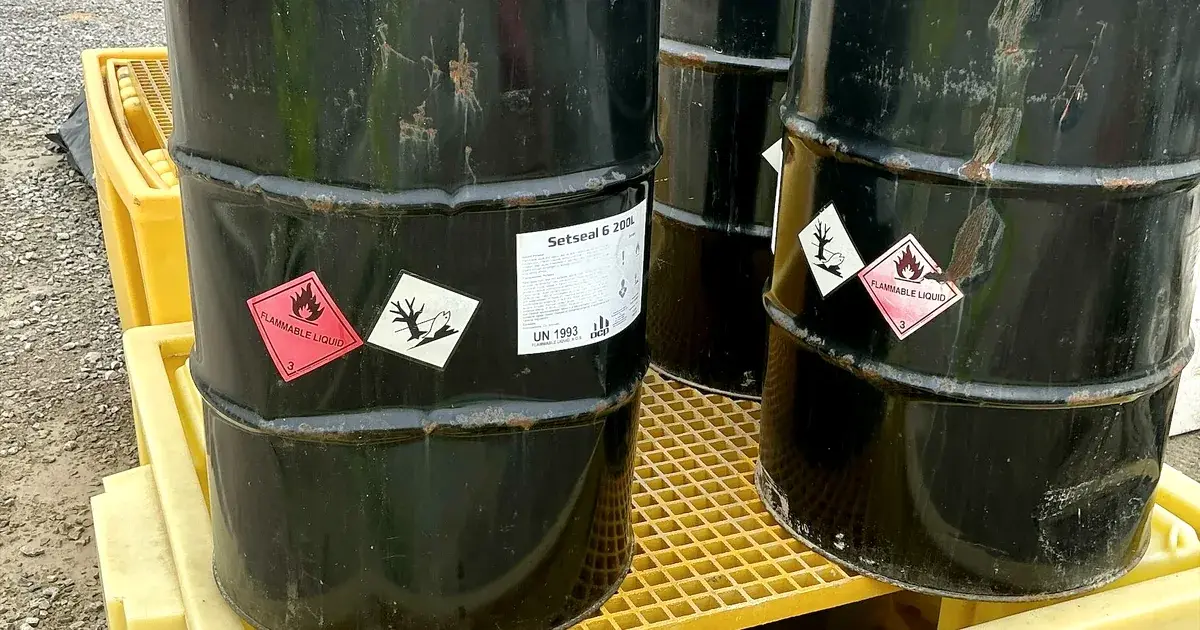
Short answer. COSHH 2002 and DSEAR 2002 regulate different risks from the same substance: COSHH covers what a substance can do to a person's health, DSEAR covers whether it can form an explosive atmosphere. Many flammable chemicals and combustible dusts trigger both regulations at once, and assessing one without the other leaves a real hazard unmanaged.
If you handle chemicals, you are probably familiar with the Control of Substances Hazardous to Health Regulations 2002 (as amended), usually shortened to COSHH. You assess hazards, put control measures in place, train people.
Somewhere in that process a different question arises: does the Dangerous Substances and Explosive Atmospheres Regulations 2002 (DSEAR) also apply? The two regulations approach the same substance from different angles, and missing the distinction can leave a real gap in your controls.
COSHH: the health focus
COSHH is concerned with health effects. A substance regulated under COSHH is one that could cause:
- Respiratory damage from inhaling vapour or dust
- Skin irritation or sensitisation
- Eye damage
- Systemic poisoning affecting organs or the nervous system
- Carcinogenic or reproductive effects
A strong solvent, for example, has a flammable vapour, but the primary COSHH concern is respiratory irritation and neurological effects from breathing it in. COSHH requires a risk assessment identifying the hazard, control measures to prevent or reduce exposure (ventilation, PPE, engineering controls), training on the hazard and its controls, health surveillance where appropriate, and documentation. The focus throughout is protecting people from the toxic effects of the substance.
DSEAR: the explosion focus
DSEAR is concerned with explosive atmosphere risk: a mixture of air and a flammable gas, vapour, mist or combustible dust that, if ignited, explodes. A flammable solvent is not regulated under DSEAR because of its health effects. It is regulated because of what it can do if it ignites.
DSEAR requires an assessment of whether an explosive atmosphere could form, classification of the area into hazardous zones where one could, control of ignition sources in those zones, use of equipment suitable for the zone, training on the risks and controls, and documentation. The focus is preventing explosive atmospheres, or controlling the risk they present when they cannot be prevented entirely.
The key difference
COSHH asks what health effect a substance could cause. DSEAR asks whether that substance could form an explosive atmosphere. These are different questions. A substance can be hazardous under COSHH without presenting any explosion risk, and a substance can present an explosion risk under DSEAR while also carrying COSHH health effects. Plenty of everyday substances trigger both.
Substances where both regulations apply
- Flammable solvents (acetone, toluene and similar): hazardous under COSHH from respiratory and neurological effects of inhalation, and relevant under DSEAR because the vapour can form an explosive atmosphere.
- Combustible dusts (grain, sawdust, flour, metal powder): some carry COSHH health effects, such as respiratory damage from certain dusts, and separately can form a dust explosion hazard under DSEAR.
- Petrol and fuel: hazardous under COSHH from vapour inhalation and skin exposure, and a DSEAR risk because the vapour is flammable.
- Flammable gases such as hydrogen: some carry an asphyxiation risk in confined spaces under COSHH, and readily form explosive atmospheres under DSEAR.
Where the overlap trips people up: a spray booth example
A spray painting operation shows the overlap clearly. A COSHH assessment identifies that inhaling paint vapour causes respiratory irritation, so the controls are spraying only in a ventilated booth and wearing respiratory protection, with training and documentation to match.
A separate DSEAR assessment identifies that paint vapour in the booth can form an explosive atmosphere. If spraying happens daily, the likelihood typically puts the booth in gas and vapour Zone 1, meaning no smoking, no hot work, and equipment in the booth suitable for that zone. Both assessments are correct, and both need to be acted on. A business that only does the COSHH assessment has missed the explosion risk; one that only does the DSEAR assessment may have controlled vapour inhalation indirectly through ventilation, but has not documented it as a COSHH control.
How to manage both
Start with the safety data sheet. It will show the health hazards relevant to COSHH and the flammability classification relevant to DSEAR. A substance classified as flammable (categories 1, 2 or 3) is likely to bring DSEAR into play; a substance with a health hazard classification brings COSHH into play. Neither classification implies the other.
Assess both risks separately. One risk assessment can cover both substances, but it needs two distinct sections: what exposure could occur and how it is controlled, and whether an explosive atmosphere could form and under what circumstances.
Build controls that address both where you can. Ventilation reduces exposure to harmful vapour under COSHH and dilutes flammable vapour concentration under DSEAR, so it earns its place twice. PPE reduces inhalation risk but is not a substitute for engineering controls under COSHH, and does nothing for ignition sources under DSEAR. Equipment chosen for a hazardous zone under DSEAR is not chosen with COSHH protection in mind, so both need thinking through independently.
Zone classification: two different schemes
Where DSEAR applies, the area is classified into zones, and the scheme depends on whether the hazard is a gas or vapour, or a combustible dust.
For flammable gases, vapours and mists, the zones are:
- Zone 0: an explosive atmosphere is present continuously or for long periods (rare outside process vessels).
- Zone 1: an explosive atmosphere is likely to occur occasionally in normal operation.
- Zone 2: an explosive atmosphere is not likely in normal operation, and if it occurs will only persist briefly.
For combustible dusts, the equivalent zones are numbered separately:
- Zone 20: a combustible dust cloud is present continuously or for long periods.
- Zone 21: a combustible dust cloud is likely to occur occasionally in normal operation.
- Zone 22: a combustible dust cloud is unlikely in normal operation, and if it occurs will only persist briefly.
A bakery handling flour is a dust example, so its production area would be classified using the 20/21/22 scheme, not the gas and vapour scheme, even though the underlying logic (how often the atmosphere is present, and for how long) is the same. Getting the scheme right matters, because it determines which equipment standard applies.
The common mistake
Plenty of organisations have a COSHH procedure and have never asked whether DSEAR applies. A spray painting workshop might have solid COSHH controls but no DSEAR assessment and no zone classification. A bakery might manage dust for hygiene reasons without ever assessing it as an explosion hazard. The reverse, assessing DSEAR but overlooking COSHH, is less common but does happen, particularly in heavy industry where flammability is obvious and health effects are less visible.
Where to start
- List every chemical and dust you handle or create.
- Check the safety data sheets for flammability classification.
- If anything is classified as flammable, or you generate combustible dust, DSEAR applies.
- Confirm a COSHH assessment is in place for every hazardous substance.
- Where both regulations apply to the same substance, confirm your controls address both risks, not just one.
- Document the approach and train people on both aspects.
York Green's DSEAR risk assessment service covers this overlap directly, checking chemical and dust hazards against both COSHH and DSEAR rather than treating them as separate exercises. For the regulations themselves, see HSE's guidance on dangerous substances and explosive atmospheres.