

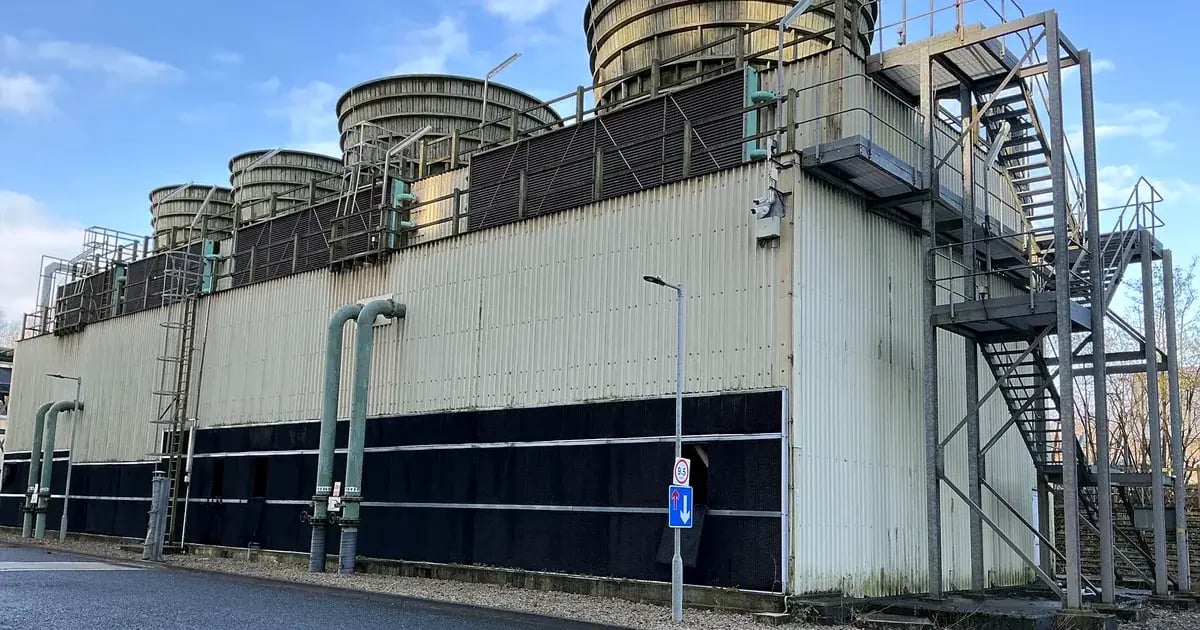
Short answer. A cooling tower is warm, aerated, continuously circulating water, exactly the conditions Legionella needs to grow, and it is designed to release a fine mist that people can inhale. It needs a documented risk assessment, a written scheme of control and regular monitoring under HSG274 and the ACOP L8, not the occasional check an air conditioning contractor happens to remember.
What a cooling tower does
A cooling tower removes heat from a building's air conditioning or an industrial process. Hot water enters the tower, cascades down through fill material, and cools mainly through evaporation. The cooled water is collected and recirculated.
It is effective engineering, and it is also close to an ideal environment for Legionella. The conditions include:
- Temperature. Water typically runs at 20 to 45°C, the range in which Legionella grows.
- Oxygenation. The cascading water and forced-air ventilation introduce oxygen.
- Nutrients. Organic matter, biofilm and minerals in the water provide food for bacteria.
- Residence time. Water sits in the system long enough for bacteria to establish.
- Circulation. Water cycles continuously, spreading any contamination through the system.
Compare that to a hot water system stored at 60°C, hot enough to kill Legionella, delivering water that reaches 50°C at the outlet within a minute, or a cold water system kept below 20°C, where growth is suppressed. A cooling tower sits in the range both of those systems are designed to avoid.
Why cooling towers carry particular risk
They are a documented outbreak source. Cooling towers have been the source of some of the most serious UK Legionella outbreaks. The Barrow-in-Furness outbreak in 2002, traced to a cooling tower at the town's arts centre, resulted in around 172 confirmed and probable cases and seven deaths.
They hold and circulate large volumes of water. A cooling tower can hold thousands of litres and circulate it continuously, so contamination anywhere in the system reaches the whole of it.
The design is open, not sealed. Water is exposed to air, which introduces oxygen and environmental bacteria, and it cannot be disinfected the way a closed pipe system can.
Biofilm forms readily. This slimy layer of bacteria and other organisms gives Legionella somewhere to establish that is partly protected from disinfection and routine control measures.
The tower generates aerosol by design. Producing a fine mist of water droplets is how the tower cools efficiently. If that mist carries Legionella, it is exactly the form people inhale. Legionella infection happens through inhaling contaminated droplets, not through drinking contaminated water.
What typically goes wrong
No one owns the system. The air conditioning contractor assumes the building owner maintains the tower; the building owner assumes the contractor does. Left unmanaged, biofilm develops and Legionella can establish within weeks or months.
Water treatment is inadequate. Cooling tower water needs chemical treatment to control pH, prevent scaling and corrosion, and control biofilm. Basic biocide dosing with nothing else can still leave Legionella surviving inside thick biofilm.
Maintenance is neglected. Fill material clogs with sediment and biofilm, the sump accumulates sludge, strainers and filters clog, and the fan and motor go unserviced, all of which make the system both less effective and more hospitable to bacteria.
Temperature creeps upward. A well-maintained tower runs around 25 to 30°C. Blocked fill, a failing fan, undersizing or high ambient temperature can push it toward 40 to 45°C, where growth risk increases further.
Older systems are harder to manage. Wooden fill material, still found in some older towers, is harder to clean and colonises more readily than modern plastic fill.
Treatment gets bypassed. A broken pipe, a leak or a design fault can let untreated water recirculate, giving Legionella an opening.
What the law requires
The Health and Safety at Work etc. Act 1974 requires reasonably practicable steps to control health risks at work, including the risk of exposure to Legionella. HSE's Approved Code of Practice L8 and the accompanying technical guidance HSG274 (in three parts, covering evaporative cooling systems, hot and cold water systems, and other risk systems) set out what that means in practice for a cooling tower:
- A documented risk assessment, specific to the system: its location, type, capacity and age, how it is used, and the Legionella risk it presents.
- A written scheme of control covering who is responsible for the system, the water treatment regime and who applies it, how the system is monitored, the maintenance and cleaning schedule, and what happens when a problem is found.
- Regular monitoring, including quarterly Legionella sampling as the baseline under HSG274 (with more frequent monitoring where risk assessment or previous results indicate it is needed), temperature checks, and biocide and pH monitoring where chemical treatment is used.
- Planned maintenance and cleaning: quarterly inspection of strainers, water level, circulation, alarms and float switches; annual cleaning of the fill and sump, corrosion checks and fan motor servicing; and periodic deep cleaning or fill replacement based on condition.
If Legionella is detected, the response is to increase biocide treatment, flush or drain the system if levels are high, increase testing frequency until it clears, work out why it was present, and adjust the control measures accordingly. A high count is not itself proof of an outbreak, but it is proof the system is not being managed adequately.
The documentation an inspector will want to see
A working scheme of control produces a paper trail: the risk assessment, a schematic of the system, the treatment regime, the monitoring schedule and who carries it out, test records for Legionella, temperature, biocide and pH, maintenance records, remedial action records where Legionella has been found, and training records for anyone involved in operating or maintaining the system. Following a Legionnaires' disease case or an HSE inspection, these records are what get examined first.
Common misconceptions
"Modern towers do not carry Legionella risk." Plastic fill is easier to manage than the old wooden type, but the risk still exists and still needs a scheme of control.
"We use a water treatment contractor, so it is not our problem." Shared responsibility is fine as long as it is written down clearly: who monitors, who acts on a problem, and who is ultimately accountable if it is not.
"Annual testing is enough." Quarterly sampling is the HSG274 baseline. Annual testing alone can leave contamination undetected for months.
"No outbreak means no risk." Many contaminated towers never cause a recognised outbreak. That is not the same as being safe.
See HSE's guidance on controlling Legionella for the full detail behind L8 and HSG274. If your building has a cooling tower and you are not confident it is being managed to that standard, York Green's Legionella risk assessment service covers the risk assessment, the scheme of control and the ongoing monitoring it depends on.