

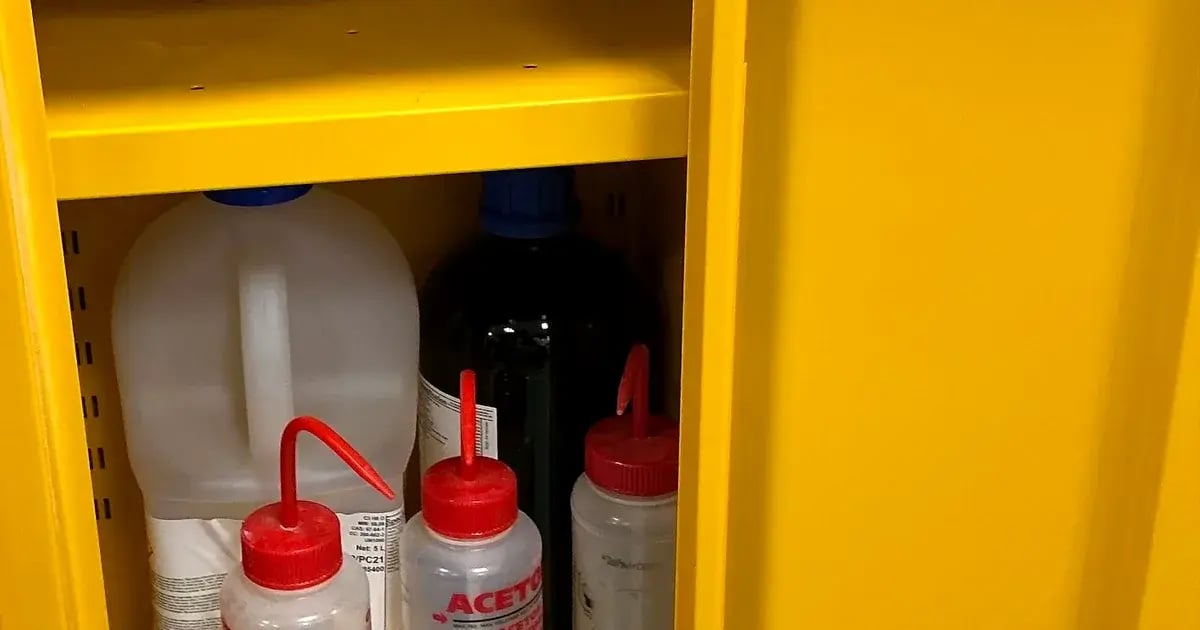
COSHH is the regulation most often assumed to be someone else's problem. Offices think it belongs to factories. Factories think it belongs to laboratories. Meanwhile the cleaning cupboard, the print room, the workshop bench and the wood dust in the extraction ducting all sit squarely inside it.
Here is what the name actually means, and what the duty actually asks of you.
What counts as a hazardous substance
Wider than most people expect. COSHH catches:
- Anything labelled with a hazard pictogram: cleaning chemicals, solvents, adhesives, paints, fuels, laboratory reagents.
- Dusts of any kind in substantial concentrations, including wood dust, flour, silica and metal dust.
- Fumes, vapours, mists and gases, including welding fume and engine exhaust.
- Biological agents: bacteria, viruses and other micro-organisms, which is why Legionella and sewage work both touch COSHH.
- Substances with a workplace exposure limit, listed in EH40.
- Substances produced by a process rather than bought in, which is the one most often missed. Nobody purchases welding fume, but it is still yours to control.
A few things sit outside COSHH because they have their own regulations: asbestos, lead, and radioactive materials. Substances that are hazardous because they burn or explode rather than because they harm health sit under DSEAR instead, and plenty of substances sit under both. A drum of solvent is a COSHH problem for what it does to the person using it and a DSEAR problem for what its vapour does in a confined space.
What the regulations require
Regulation 6 is the one everyone quotes: you must not carry out work liable to expose employees to a substance hazardous to health unless you have first made a suitable and sufficient assessment of the risk, and of the steps needed to meet the rest of the regulations.
What follows from that assessment is a sequence, and the order matters:
- Prevent exposure if it is reasonably practicable to do so. Usually by not using the substance, or by using a less hazardous one.
- Control exposure where prevention is not reasonably practicable, applying the principles of good practice in Schedule 2A.
- Maintain the controls. Local exhaust ventilation needs a thorough examination and test at least every 14 months.
- Monitor exposure where the assessment says it is needed, or where a substance has a workplace exposure limit that could be exceeded.
- Provide health surveillance where there is an identifiable disease linked to the exposure and a valid way of detecting it.
- Inform, instruct and train everyone exposed, and plan for spills, leaks and emergencies.
Personal protective equipment sits at the bottom of that sequence, not the top. A respirator issued because it was easier than fixing the extraction is a control failure with a receipt attached.
What a COSHH assessment looks like
It is not a filed safety data sheet. A safety data sheet tells you what the substance is; a COSHH assessment tells you what happens when your people use it, in your building, in the quantities and the way they actually use it.
A usable assessment records the substance and its hazards, who is exposed and for how long, the route of exposure, the controls already in place, whether those controls are adequate, and what needs to change. It names the task, not just the product. The same tin of solvent used with a brush in a ventilated bay and decanted by hand in a store cupboard produces two different assessments.
Assessments have to be reviewed regularly, and immediately if there is reason to think they are no longer valid: a new substance, a changed process, a new piece of information on the label, or a case of ill health.
The failings we see most often
Across the assessments our consultants carry out, the same handful come up again and again.
- An inventory that does not match the shelves. Substances arrive through purchasing, through contractors and through someone bringing in something that works better. The register lags behind.
- Process-generated substances missing entirely. Dust, fume and vapour do not come with a data sheet, so they do not get assessed.
- Extraction that has never been tested. LEV that pulls nothing, or pulls into a filter last changed years ago. The 14-month examination is a legal requirement, not a service interval.
- Health surveillance not started. Where the exposure warrants it and nothing has been set up, this is the failing with the longest tail, because the evidence of harm accumulates quietly.
- Assessments written for the file. If the person doing the task has never seen the assessment and cannot say what the controls are, it is not doing its job.
- Decanted substances in unlabelled containers. Common, quick to fix, and consistently one of the first things an inspector notices.
Where to start if you have nothing
Walk the site with a notebook and list every substance you find, including the ones in unlabelled bottles and the ones generated by your own processes. Match each to a safety data sheet. Then group by task rather than by product, because that is how exposure actually happens, and work through the tasks with the biggest exposure first.
The HSE's own guidance at hse.gov.uk/coshh is a good grounding, and its COSHH essentials sheets give practical control advice for common tasks.
Getting it assessed properly
York Green's assessors carry out COSHH assessments across manufacturing, water treatment, laboratories, education and general industry. What you get back is a written assessment per task, with the controls checked against what is actually in place rather than what the file says, and an action list you can work through.
See our COSHH assessment service, or email enquiries@yorkgreen.uk to talk about your site.